

10 U.S. Cities and Towns That May Pay You to Move There in 2026
A practical relocation guide for renters, homebuyers, and remote workers exploring U.S. cities offering moving incentives, cash grants, housing support, and lifestyle perks in 2026.
MyEstateManager Team · 18 min read · 44 views · 0 comments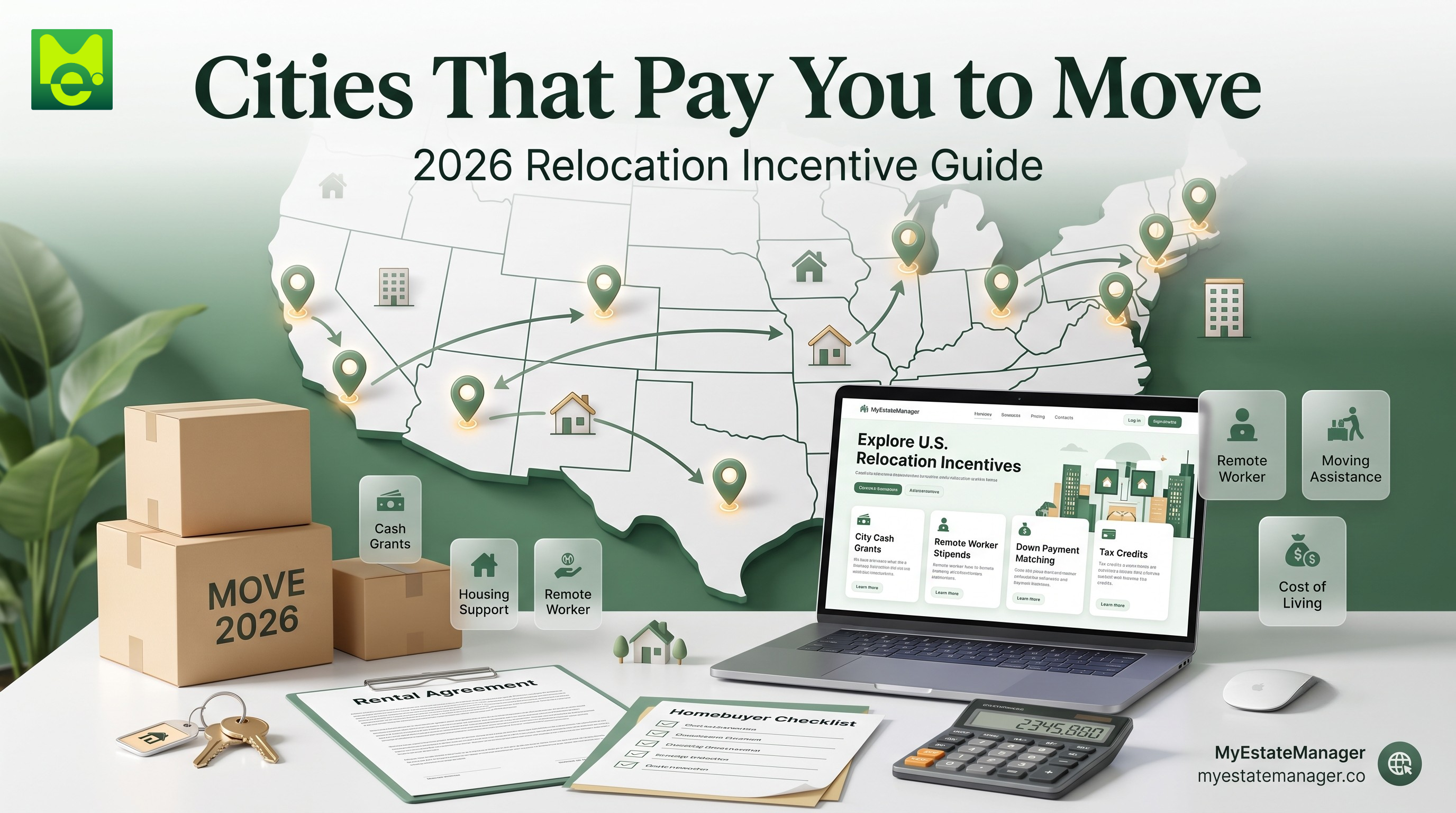
Some U.S. cities and towns are offering relocation incentives to attract remote workers, homebuyers, renters, and families. This guide explains 10 places that may pay you to move, what the incentives include, and how to evaluate housing costs before relocating
Overview
MyEstateManager Relocation Guide 🏡
10 U.S. Cities and Towns That May Pay You to Move There in 2026
A practical guide for renters, homebuyers, remote workers, and families exploring relocation incentives, housing support, lifestyle perks, and the real costs behind moving
Introduction 🌍
Moving to a new city is usually expensive, stressful, and full of uncertainty.
You may need to pay for movers, deposits, temporary housing, utility setup, furniture, school changes, vehicle registration, insurance adjustments, and unexpected home repairs.
That is why relocation incentive programs have become so attractive.
Across the United States, several cities, towns, and regions are offering cash grants, down payment assistance, relocation reimbursements, coworking space, outdoor recreation perks, homebuilding grants, or local service packages to attract new residents.
These programs are often designed for remote workers, homebuyers, job seekers, veterans, entrepreneurs, or families who are willing to settle in smaller or mid-sized communities.
MakeMyMove describes this trend clearly by saying communities across the U.S. are welcoming new residents with incentives, signing bonuses, networking opportunities, and relocation support, and the platform says it has helped more than 4,000 people move since 2021.
For MyEstateManager readers, the opportunity is not only about free money.
The smarter question is whether the incentive actually improves your housing stability, cost of living, homeownership plan, rental situation, work-life balance, and long-term property decision.
This guide reviews 10 cities, towns, and regions that may pay you or support you to move there, explains what each incentive means, and shows how to evaluate the housing side before making a major relocation decision.
Important Relocation Note ⚠️
Relocation programs change frequently.
Some programs close applications, change eligibility rules, reduce funding, pause offers, or update incentive values without much public notice.
Before planning a move, always verify the latest program status directly with the city, official program website, employer partner, housing authority, or relocation platform.
Also remember that a relocation grant is not the same as free housing.
You still need to calculate rent, mortgage payments, property taxes, insurance, utilities, maintenance, commute, healthcare, childcare, local job security, and whether the city fits your lifestyle.
Why Cities Pay People To Move There 💰
Many smaller cities and towns face population decline, aging demographics, vacant housing, lower workforce growth, or difficulty attracting skilled professionals.
Relocation incentives are one way to bring in remote workers, homebuyers, entrepreneurs, healthcare workers, teachers, veterans, and job seekers who can spend locally, buy homes, rent apartments, join community groups, and support local businesses.
Business Insider reported in 2026 that U.S. cities and towns are offering cash grants, housing assistance, and lifestyle perks to attract new residents, especially remote workers.
The logic is simple.
If a city can attract a stable household, that household may rent or buy property, pay local taxes, shop at local stores, hire local services, enroll children in schools, and contribute to community life.
For movers, the benefit is also clear.
A relocation incentive can reduce the pain of moving expenses, help with a down payment, make a smaller market more attractive, or create a financial bridge while settling into a new home.
Graph 1: Selected Relocation Incentive Values 📊
The chart below compares maximum published incentive or program values from selected relocation and homebuyer programs.
These numbers are not direct apples-to-apples comparisons because some are cash grants, some are down payment assistance, some are homebuilding grants, and some are total package values that include perks.
Maximum Reported Incentive Or Package Value
Jackson, Michigan $35,000
Texarkana, USA $18,900
Hutchinson, Kansas $15,500
Topeka, Kansas $15,000
Ascend West Virginia $12,000 cash
Tulsa, Oklahoma $10,000
Chart note: values are based on published program pages and 2026 reporting, but eligibility and availability may change.
Quick Comparison Table 🧾
1. Tulsa, Oklahoma 🏙️
Tulsa is one of the best-known relocation incentive examples in the United States.
The Tulsa Remote program offers a $10,000 grant to help remote workers make Tulsa their new home base, and the official program page says it has welcomed more than 4,000 remote workers since launching in late 2018.
The key advantage of Tulsa is that the offer is not only about cash.
The program also promotes community support, remote-worker networking, local resources, and a built-in group of people who have moved for similar reasons.
For renters, Tulsa may be attractive as a test market before committing to ownership.
For homebuyers, the grant can reduce relocation pressure while they study neighborhoods, commute patterns, school zones, insurance costs, and local property taxes.
MyEstateManager tip: do not buy immediately just because the incentive sounds strong.
Renting for 6 to 12 months can help you understand the city before choosing a property.
2. Morgantown Area, West Virginia ⛰️
Ascend West Virginia is one of the most lifestyle-focused relocation programs.
The official Ascend WV site says remote workers can receive $12,000, free outdoor recreation, free coworking space, and social programming, with applications open across five Ascend communities including the Morgantown Area, Greenbrier Valley, Eastern Panhandle, Greater Elkins, and New River Gorge.
Ascend also states that its outdoor recreation benefits are worth well over $2,500, including free gear rentals and outdoor experiences.
For homebuyers, the West Virginia angle is not only about the incentive.
It is about whether the move creates a lower-cost lifestyle, better access to nature, and a community fit that supports long-term settling.
For property decision-making, remote workers should compare local broadband quality, winter maintenance, commute distance to healthcare, resale demand, and whether the home is suited for a work-from-home setup.
3. Topeka, Kansas 🌾
Topeka’s Choose Topeka program has become a frequently cited example of employer-linked relocation incentives.
Recent reporting notes that Topeka offers up to $15,000 through Choose Topeka, while a 2026 Business Insider profile described a buyer who received $15,000 after moving back to Topeka and buying a home.
Other reporting explains that the program can involve employer participation and that recipients are generally required to stay in the area for at least one year.
For homebuyers, Topeka can be interesting because the incentive is closely tied to employment and settlement.
That means the program is not simply paying people to pass through.
It is designed to attract people who will work, live, spend, and participate locally.
MyEstateManager tip: before relying on this incentive, confirm whether your employer participates, whether you need to buy inside Shawnee County, and when the payment is actually released.
4. Jackson, Michigan 🏠
Jackson, Michigan stands out because the incentive is strongly tied to homeownership and down payment support.
Business Insider reported that Jackson’s 100 Home Program plans to construct 100 one- and two-bedroom homes on vacant residential lots, each priced at $175,000, with up to $25,000 in city down payment assistance for eligible applicants and a possible extra $10,000 through Michigan State Housing Development Authority assistance.
New York Post reporting described Jackson as offering up to $35,000 in total aid, equal to nearly 20% of a qualifying home’s value in the example cited.
This is one of the most property-focused programs on the list.
It may appeal to renters who are ready to become first-time buyers, buyers with stable income but limited down payment savings, and households seeking a smaller city with a more direct path into ownership.
MyEstateManager tip: check income limits, credit score requirements, mortgage pre-approval, home availability, deed restrictions, resale conditions, maintenance expectations, and whether the assistance is a grant or has repayment rules.
5. West Memphis, Arkansas 🌉
West Memphis sits across the Mississippi River from Memphis, Tennessee, and uses relocation incentives to attract new residents.
Business Insider reported that West Memphis offers housing incentives of up to $10,000 for homebuyers and up to $5,000 for renters, along with lifestyle perks through MakeMyMove.
This structure is useful because it does not force every mover into the same housing decision.
Some people should rent first.
Others may be ready to buy.
A relocation program that offers both buyer and renter pathways may help movers choose based on financial readiness rather than pressure.
For renters, the incentive can help offset deposits, moving costs, furnishings, or the first months of adjustment.
For buyers, the incentive can improve the cash position at closing.
MyEstateManager tip: compare West Memphis housing costs with nearby Memphis neighborhoods, commute routes, taxes, insurance, flood considerations, and long-term resale demand.
6. Newton, Iowa 🏡
Newton, Iowa is often discussed as a homebuyer-focused incentive location.
New York Post reported that Newton offers $10,000 for buyers of new homes priced at $240,000 or more, describing the incentive as about 4.2% of the home price in its example.
This type of program is different from remote-worker cash programs.
It is more directly connected to new-home construction and residential development.
That can be attractive for buyers who prefer a newly built home over an older property that may require repairs.
However, new construction still needs careful analysis.
Buyers should review builder reputation, warranty coverage, lot location, HOA rules if applicable, utility costs, insulation quality, property tax projections, and whether the local resale market can support the purchase price.
MyEstateManager tip: never assume a new home means no maintenance.
Plan for landscaping, window coverings, appliances, utility setup, exterior care, and emergency repairs even if the house is newly built.
7. Mattoon, Illinois 🌳
Mattoon, Illinois targets remote workers with a relocation package that includes cash and practical local services.
New York Post reported that Mattoon offers a $5,000 cash incentive, about $3,000 in local services, and a year of free coworking space for qualifying remote workers moving from more than 100 miles away.
The qualification details reported include remote-work income requirements and a commitment to live within city limits for at least two years.
This is the kind of program that may work well for people who want a smaller community but still need work-from-home support.
The coworking benefit matters because not every remote worker wants to work from a kitchen table every day.
For renters, this package may lower the risk of testing the city.
For buyers, it may be best to rent first, then purchase after learning the market.
MyEstateManager tip: check internet reliability, coworking access, lease terms, pet rules, parking, and whether local housing inventory matches your needs.
8. Paducah, Kentucky 🎨
Paducah, Kentucky has built its relocation appeal around remote work, arts, affordability, and community identity.
New York Post reported that Paducah launched a Remote Workers Incentive Program worth nearly $6,500 in benefits, including moving expense reimbursement, waived payroll taxes for a year, internet support, and local memberships or passes.
The Sun separately reported that remote workers could receive moving-related reimbursement, monthly internet assistance, and a quality-of-life package, with requirements such as living at least 100 miles away, working full-time remotely for a nonlocal employer, and committing to stay beyond the program period.
Paducah may be especially interesting for remote professionals who value arts, walkable cultural districts, and lower-cost living.
However, moving for lifestyle should still be treated like a housing decision.
Before moving, compare rental inventory, average utility bills, home insurance, local repair contractors, healthcare access, school options, and whether you need a car for daily life.
MyEstateManager tip: a quality-of-life package is useful, but your monthly housing cost will matter much more over time.
9. Hutchinson, Kansas 🚀
Hutchinson, Kansas appears among MakeMyMove’s trending programs for remote workers.
MakeMyMove listed “Live and Work Remote in Hutchinson” as a program with a $15,500 program value, 15 benefits, and cash included.
For movers, this type of package is worth reviewing because total program value can include more than direct cash.
It may include networking, relocation support, coworking, local experiences, community introductions, or service discounts.
That can make settling easier, especially for people moving alone or families relocating to a place where they do not yet have a support system.
MyEstateManager tip: ask which parts of the package are cash, which are services, which are one-time perks, and which require you to remain in the city for a defined period.
10. Texarkana, USA 🌎
Texarkana is unusual because it is a border-region community associated with both Texas and Arkansas.
MakeMyMove listed “Call Texarkana Home” as a remote-worker program with a $18,900 program value, 13 benefits, and cash included.
This may appeal to remote workers who want a lower-cost lifestyle, a regional location, and community support while keeping access to two-state cultural and economic advantages.
For housing, the border-city element makes due diligence especially important.
Taxes, insurance, licensing, school districts, utilities, and legal details may vary depending on which side of the area you choose.
MyEstateManager tip: before renting or buying, compare both sides carefully and confirm which jurisdiction affects your property taxes, registration, services, and daily living costs.
Graph 2: What Type Of Incentive Are You Really Getting? 🧭
Not all relocation incentives solve the same problem.
Some help with cash flow, some support homeownership, and some mainly improve the settling-in experience.
Relocation Incentive Type By Practical Value
Down payment assistance Strongest for buyers
Direct cash grant Flexible
Moving reimbursement Useful but limited
Coworking and community perks Helpful for settling
Tourism and lifestyle passes Nice extra
Chart note: this is an editorial housing-usefulness ranking for MyEstateManager readers, not a market survey.
How To Evaluate A Relocation Incentive Before Moving ✅
A relocation incentive can be useful, but it should not control the entire decision.
The wrong move can cost more than the incentive saves.
Before applying, build a complete relocation budget.
Relocation Budget Checklist
- Moving company or truck rental
- Temporary lodging
- Security deposit or down payment
- First month rent or mortgage costs
- Utility setup fees
- Internet installation
- Vehicle registration and insurance changes
- Storage costs if needed
- Furniture and appliances
- Property taxes and home insurance
- Maintenance and repair reserve
- Travel costs for home tours or rental viewings
You should also confirm when the incentive is paid.
Some programs pay after residency is established.
Some reimburse expenses after proof is submitted.
Some require a one-year or two-year commitment.
Some require local employment, remote employment, minimum income, home purchase, mortgage approval, or application approval before moving.
If the payment arrives after the move, you still need enough cash to relocate without relying on money that has not been released yet.
Rent First Or Buy First? 🏘️
One of the biggest questions for movers is whether to rent first or buy immediately.
Renting first is usually safer when you do not know the city well.
It gives you time to test neighborhoods, commute routes, climate, school zones, local services, property managers, grocery access, healthcare access, and community fit.
Buying first can make sense when the program is directly tied to homeownership, when you have visited the area, when you understand the local market, and when the incentive significantly reduces upfront cost.
For example, a down payment assistance program may be more valuable to a buyer than to a renter.
A direct cash grant may be more flexible for a renter who wants time before buying.
A coworking and community package may be most useful for remote workers who need social and professional support after arrival.
Red Flags To Watch Before Applying 🚩
The first red flag is unclear eligibility.
If you cannot understand who qualifies, when payment is made, or what proof is needed, ask before applying.
The second red flag is buying a property only to get the incentive.
A weak house, bad location, high insurance cost, poor resale demand, or major repair burden can erase the value of any grant.
The third red flag is assuming the city will fit your lifestyle because the incentive is high.
Visit first if possible.
The fourth red flag is ignoring taxes.
Some incentives may have tax implications, and state or local tax rules can affect your total cost of living.
The fifth red flag is not planning for maintenance.
Homeownership always includes repairs, seasonal upkeep, insurance, utilities, and emergency costs.
MyEstateManager Relocation Decision Framework 🧩
Use The M O V E Framework
M — Money: Compare incentive value with total moving cost, housing cost, taxes, utilities, and maintenance.
O — Occupancy: Decide whether renting or buying gives you the safest first-year plan.
V — Verification: Confirm application status, eligibility, payment timing, and legal requirements directly with the program.
E — Exit plan: Understand what happens if the city is not the right fit or your job situation changes.
This framework keeps the decision practical.
A relocation program should support a good move, not pressure you into a bad one.
The best city is not always the one offering the highest incentive.
The best city is the one where your income, housing costs, lifestyle, job security, and long-term plans work together.
FAQs ❓
Do cities really pay people to move there?
Yes, some cities, towns, and regions offer relocation incentives such as cash grants, down payment assistance, moving reimbursement, coworking space, student loan help, or lifestyle perks to attract new residents.
Who usually qualifies for relocation incentives?
Many programs target remote workers, full-time employees, job seekers, homebuyers, veterans, or people who live outside the city or state before applying.
Should I buy a house just to qualify for an incentive?
No, you should only buy if the property, location, mortgage, maintenance costs, taxes, and long-term plan make sense even without the incentive.
Are relocation incentives taxable?
They may be taxable depending on the program structure and your personal situation, so you should ask the program administrator and consult a tax professional before relying on the full amount.
Is renting first better than buying immediately?
Renting first is often safer when you do not know the city, while buying may make sense if the incentive is homebuyer-focused and you have already researched the local market carefully.
Final Verdict 🏁
Cities that pay people to move are no longer just viral internet stories.
They are part of a growing local economic development strategy designed to attract remote workers, homebuyers, skilled employees, families, and community-minded residents.
Programs in places like Tulsa, West Virginia, Topeka, Jackson, West Memphis, Newton, Mattoon, Paducah, Hutchinson, and Texarkana show that relocation incentives can take many forms.
Some are direct cash grants.
Some are homebuyer assistance programs.
Some are coworking and community packages.
Some are lifestyle perks designed to help newcomers settle.
For MyEstateManager readers, the best approach is practical.
Do not chase the largest incentive.
Chase the best housing decision.
Study the city, verify the program, calculate the true cost of moving, inspect rental and purchase options, and make sure the move still makes sense after the incentive is gone.
A relocation grant can open the door, but a smart housing plan keeps you stable after you arrive.
MyEstateManager Insight 🚀
The smartest relocation decision is not the one with the biggest check. It is the one where income, housing cost, lifestyle, maintenance, and long-term stability all make sense together.
Get Property GuidanceReferences 📚
- Tulsa Remote official program page for the $10,000 grant and participant count.
- Ascend West Virginia official program page for the $12,000 cash incentive, outdoor recreation benefits, coworking space, social programming, and participating communities.
- MakeMyMove official homepage for relocation program trend data, program values, and active examples such as Hutchinson and Texarkana.
- Business Insider 2026 relocation incentive roundup for Jackson, West Memphis, Paducah, and broader U.S. relocation incentive examples.
- New York Post 2026 homebuyer incentive roundup for Jackson, Topeka, West Memphis, Newton, Mattoon, Tulsa, Morgantown, and St. Joseph examples.
- Business Insider 2026 Topeka case study showing a $15,000 Choose Topeka incentive used by a homebuyer.
- Paducah relocation incentive reporting covering moving reimbursement, internet support, payroll tax waiver, and local benefit package.
- Mattoon relocation incentive reporting covering $5,000 cash, local services, coworking space, and eligibility requirements.
Leave a Comment
Your email will be verified but will never be displayed publicly.
Join the Conversation
0 approved comments. Share a useful perspective after email verification.
No comments yet. Be the first to add a helpful perspective.