

How to Price Your Home to Sell Fast: A Smart Seller’s Guide
A practical guide to pricing your home correctly, attracting serious buyers, and selling faster without losing value
MyEstateManager Team · 14 min read · 39 views · 0 comments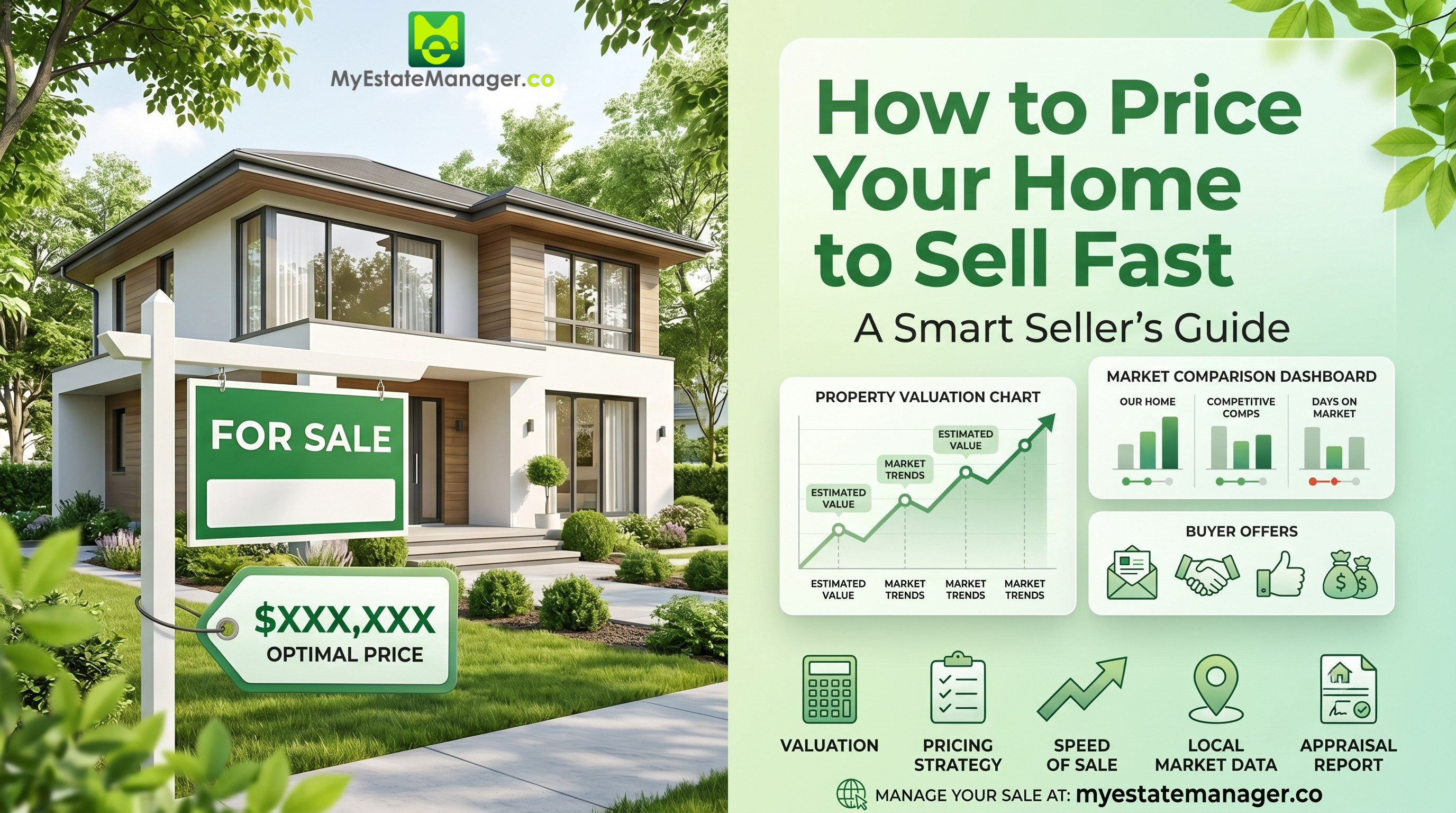
Pricing your home correctly is one of the most important steps in the selling process. This guide explains how to use market comparisons, buyer psychology, property condition, location, and selling timelines to choose a smart asking price that attracts serious buyers and helps your home sell faster.
New Section
🌿 Introduction: Why Home Pricing Matters More Than You Think
Selling a home is not only about listing it online, taking beautiful photos, and waiting for buyers to appear. One of the most powerful factors behind a successful sale is the asking price. Price your home correctly, and you can attract attention quickly. Price it too high, and it may sit on the market for weeks or months. Price it too low without strategy, and you may lose money that could have stayed in your pocket.
Many homeowners believe their property is worth more because of personal attachment, renovation costs, emotional memories, or future expectations. While these feelings are natural, buyers usually think differently. Buyers compare your home with similar properties, neighborhood prices, condition, location, size, features, and market demand. They do not pay for your memories. They pay for value.
This is why home pricing must be based on facts, not guesswork. A good pricing strategy looks at recent comparable sales, active competition, property condition, location, buyer demand, market timing, and the seller’s goal. It also considers how buyers search online and how price brackets influence visibility.
In this guide, we will explain how to price your home to sell, how to avoid common pricing mistakes, and how to make your property look like a smart choice in the eyes of buyers.
🏡 Understand the Difference Between Value and Asking Price
Before setting a price, it is important to understand the difference between market value and asking price. Market value is what buyers are realistically willing to pay based on current conditions. Asking price is the number you choose to list your home for.
These two numbers should be close, but they are not always the same. A seller may ask for more than the market value because they want negotiation room. Another seller may list slightly below market value to attract more buyers and create competition. The right strategy depends on your market and your selling goal.
If your asking price is far above market value, buyers may ignore your listing. They may assume you are not serious or that the home is overpriced. If your asking price is too low without a clear plan, buyers may become suspicious or you may leave money on the table.
A smart asking price should make buyers feel that the home is fairly valued, worth viewing, and worth making an offer on.
📊 Start With a Comparative Market Analysis
A comparative market analysis, often called a CMA, is one of the best tools for pricing a home. It compares your property with similar homes that have recently sold, are currently listed, or were listed but did not sell.
The most important comparison is recent sold properties. Active listings show your competition, but sold properties show what buyers actually paid. This matters because asking prices can be unrealistic, while sold prices reflect real market behavior.
What to Compare
- Property size and covered area
- Plot size or land area
- Number of bedrooms and bathrooms
- Location and street quality
- Property condition
- Age of construction
- Renovations and upgrades
- Parking space and access
- Nearby schools, markets, roads, and facilities
- Recent sale prices in the same area
Try to compare your home with properties that are as similar as possible. A luxury renovated house should not be compared with an older house needing major repairs. A corner property may not be equal to an inner street property. A home near a main road may have a different value than one deep inside a quiet block.
🔍 Study Your Competition Carefully
When you list your home, you are not selling in isolation. Buyers will compare your property with other homes available in the same budget. If your price is higher than similar homes, your property must clearly justify the difference.
Look at active listings in your neighborhood. Check how many similar homes are for sale. Notice their prices, photos, condition, features, and descriptions. If there are many properties available, buyers have more choices. In that case, overpricing becomes more dangerous.
If your home is priced higher than competing homes, ask yourself why. Does it have better construction? Better location? More space? Better renovation? More parking? A stronger rental potential? If the answer is unclear, buyers may choose another property.
Questions to Ask
- How many similar homes are currently listed?
- Are they priced lower, higher, or similar to my home?
- Which homes look more attractive online?
- Which homes offer better value for buyers?
- How long have competing properties been on the market?
- Are sellers reducing prices after no response?
This research helps you position your property correctly. Your goal is not only to set a price. Your goal is to make your home look like one of the best choices in its category.
🧠 Understand Buyer Psychology
Buyers do not only respond to numbers. They respond to perception. A home priced at the right level feels fair, attractive, and worth visiting. A home priced too high feels risky. Buyers may think, “The seller is unrealistic,” or “There must be better options.”
Buyers also search within price ranges. For example, a buyer may search for homes between a certain minimum and maximum budget. If your home is priced just above a common search range, you may miss many potential buyers.
Smart pricing considers these search brackets. Sometimes a small price adjustment can increase visibility. For example, listing at a clean round bracket or slightly below a major search limit can help your home appear in more buyer searches.
Another important psychological factor is freshness. New listings usually receive the most attention in the first few weeks. If your home enters the market overpriced, it may waste its strongest exposure period. Later, even after a price reduction, buyers may wonder why it has not sold.
🏚️ Be Honest About Your Home’s Condition
Condition plays a major role in pricing. Two homes in the same street can have different values if one is modern, clean, and well-maintained while the other needs repairs. Buyers notice details such as paint, flooring, kitchen condition, bathrooms, plumbing, electricity, lighting, dampness, doors, windows, and roof condition.
Sellers often overestimate the value of renovations. Not every improvement adds equal value. Some upgrades are personal taste rather than market value. For example, expensive custom décor may not appeal to every buyer. However, practical improvements such as clean bathrooms, functional kitchens, fresh paint, good lighting, and repaired faults can improve buyer confidence.
If your home needs repairs, you have two choices. You can fix the issues before listing, or you can price the home accordingly. What you should not do is ignore the problems and price the home like a fully updated property.
Condition Factors That Affect Price
- Overall cleanliness and presentation
- Structural condition
- Kitchen and bathroom quality
- Paint, flooring, and ceiling condition
- Plumbing and electrical systems
- Natural light and ventilation
- Outdoor space and entrance appeal
- Maintenance history
📍 Location Still Controls Value
You can improve a home, but you cannot move it. Location remains one of the strongest pricing factors in real estate. Buyers pay more for convenience, security, access, and neighborhood quality.
A home near schools, parks, markets, hospitals, main roads, public transport, and business areas may attract more demand. A property in a secure, clean, and well-developed neighborhood usually has stronger pricing power. On the other hand, homes in noisy, poorly maintained, or difficult-access areas may need more competitive pricing.
Even within the same neighborhood, small location differences matter. A corner house may command a premium. A home on a wider road may sell faster. A property near a commercial area may be attractive to some buyers but less attractive to families seeking quiet surroundings.
Pricing should reflect these location advantages and disadvantages honestly.
💰 Avoid the Biggest Mistake: Overpricing
Overpricing is one of the most common reasons homes do not sell. Some sellers believe they can start high and reduce later if needed. While this sounds logical, it can backfire.
When a home first comes on the market, it usually gets the most attention. Serious buyers, agents, and online viewers notice new listings quickly. If the price is too high, many buyers will skip it. After several weeks, the listing may become stale. People may assume something is wrong with the property.
Price reductions can help, but they do not always recover the lost momentum. Buyers may start making lower offers because they sense the seller is under pressure.
| Pricing Choice | Buyer Reaction | Possible Result |
|---|---|---|
| Fair market price | Feels reasonable and worth viewing | More enquiries and stronger offers |
| Slightly below market | Creates urgency and competition | Fast response and possible multiple offers |
| Too high | Feels unrealistic | Low interest and longer market time |
| Too low without strategy | May create suspicion or loss | Fast sale but possible money left behind |
📸 Price and Presentation Must Work Together
Even the right price can underperform if the home is poorly presented. Buyers make quick judgments from photos, descriptions, and first impressions. If the property looks dark, cluttered, dirty, or badly photographed, buyers may undervalue it.
Before listing, prepare the home carefully. Clean every room, remove clutter, fix small issues, improve lighting, arrange furniture neatly, and make the entrance attractive. A well-presented home supports your asking price.
Good photos are also essential. Online buyers often decide whether to visit based on images. Bright, clear, wide-angle photos can make the home feel more spacious and appealing. Poor photos can make even a good property look weak.
Simple Presentation Improvements
- Clean and declutter every room
- Repair small visible issues
- Use fresh paint where needed
- Improve lighting and ventilation
- Remove unnecessary personal items
- Make the entrance clean and welcoming
- Use high-quality listing photos
- Write a clear and honest property description
⏳ Match Price With Your Selling Timeline
Your timeline should influence your pricing strategy. If you need to sell quickly, you may need to price more competitively. If you are not in a hurry, you may have more room to test the market, but you should still avoid unrealistic pricing.
A seller who wants a fast sale should focus on attracting serious buyers immediately. This usually means pricing close to market value or slightly below similar competing properties. A seller with more time can list at a confident but realistic price and monitor response carefully.
However, time does not always help an overpriced home. If the market does not support the price, waiting longer may not solve the problem. Buyers may simply continue choosing better-priced homes.
📉 Watch the Market Response After Listing
Once your home is listed, the market will give you feedback. Pay attention to online views, enquiries, showing requests, agent feedback, buyer comments, and offer activity.
If your listing receives strong views and multiple enquiries, your price may be aligned with demand. If it receives views but very few enquiries, buyers may be interested but not convinced by the price or presentation. If it receives almost no views, the listing may have visibility, photography, platform, or pricing issues.
Do not ignore feedback. A smart seller adjusts based on evidence. If the market clearly rejects the price, reducing earlier is usually better than waiting too long.
Market Feedback Signs
- High views and strong enquiries: price may be attractive
- High views but low enquiries: price or photos may be weak
- Many showings but no offers: condition or value mismatch may exist
- Low views: listing visibility or pricing bracket may be wrong
- Repeated negative feedback: adjustment is needed
🤝 Leave Room for Negotiation, But Be Realistic
Negotiation is part of home selling. Many buyers expect some flexibility. However, adding too much negotiation room can make the starting price look unattractive. If the price is too high, buyers may not even start a conversation.
A better approach is to price realistically and keep a sensible negotiation margin. This encourages buyers to engage while still protecting your final amount.
Sellers should also understand their minimum acceptable price before listing. This helps avoid emotional decisions during negotiations. Know your ideal price, realistic price, and lowest acceptable price. Also consider closing costs, repair requests, taxes, agent fees, and moving expenses.
Good negotiation begins before the offer arrives.
✅ Home Pricing Checklist for Sellers
Before finalizing your asking price, review this checklist:
- Check recent sold prices of similar homes
- Study active competition in your area
- Review property condition honestly
- Consider location advantages and weaknesses
- Understand buyer search price brackets
- Decide your selling timeline
- Estimate repair and presentation costs
- Calculate your minimum acceptable price
- Prepare high-quality photos and description
- Monitor market response after listing
- Be ready to adjust if buyer interest is weak
This checklist can help you avoid emotional pricing and make a more confident decision.
🚫 Common Pricing Mistakes to Avoid
Many sellers make pricing mistakes because they focus on personal expectations instead of market reality. Avoid these common errors:
- Pricing based only on what you need financially
- Comparing your home with larger or better properties
- Ignoring recent sold prices
- Adding full renovation cost to the asking price
- Starting too high and assuming you can reduce later
- Ignoring buyer feedback
- Refusing to adjust after weak market response
- Using poor photos while asking a premium price
- Pricing emotionally because of personal memories
- Failing to understand local competition
The goal is not to underprice your home. The goal is to price it correctly so that serious buyers feel confident enough to act.
🌱 When Should You Reduce the Price?
A price reduction is not a failure. Sometimes it is a smart correction based on market feedback. If your home has been listed for several weeks with little interest, few showings, and no serious offers, it may be time to review the price.
Before reducing, check other factors first. Are the photos strong? Is the description clear? Is the property listed on the right platforms? Is the home clean and presentable? Are agents actively showing it? If these areas are strong and buyers still show little interest, the price is likely the issue.
A meaningful price adjustment is usually better than a tiny reduction that buyers barely notice. The new price should place the home in a more attractive search range and make it competitive against similar options.
🏁 Final Pricing Strategy: Balance Confidence With Reality
Pricing your home to sell is a balance between confidence and market reality. You should not undersell a valuable property, but you should also avoid asking for a price the market will not support.
The strongest pricing strategy is built on research. Study comparable sales. Understand your competition. Be honest about condition. Respect location factors. Think like a buyer. Prepare your home well. Monitor feedback after listing.
When all of these elements work together, your home becomes easier to sell. Buyers see value. Agents take interest. Online listings perform better. Negotiations become stronger. The entire selling process becomes smoother.
💚 Conclusion: The Right Price Helps Your Home Sell Smarter
Pricing your home is one of the most important decisions you will make as a seller. A good price can attract attention, create trust, bring serious buyers, and reduce the time your property spends on the market. A poor price can lead to silence, delays, weak offers, and frustration.
The right price is not based on emotion, guesswork, or what someone else is asking. It is based on real market data, buyer behavior, property condition, location, and timing.
If you want to sell successfully, think like a buyer while protecting your value as a seller. Make your home attractive, price it honestly, and respond wisely to market feedback.
A well-priced home does not just sell faster. It sells with more confidence.
🏡 Final Thought: The market decides value, but smart pricing helps the market choose your home first.
Leave a Comment
Your email will be verified but will never be displayed publicly.
Join the Conversation
0 approved comments. Share a useful perspective after email verification.
No comments yet. Be the first to add a helpful perspective.